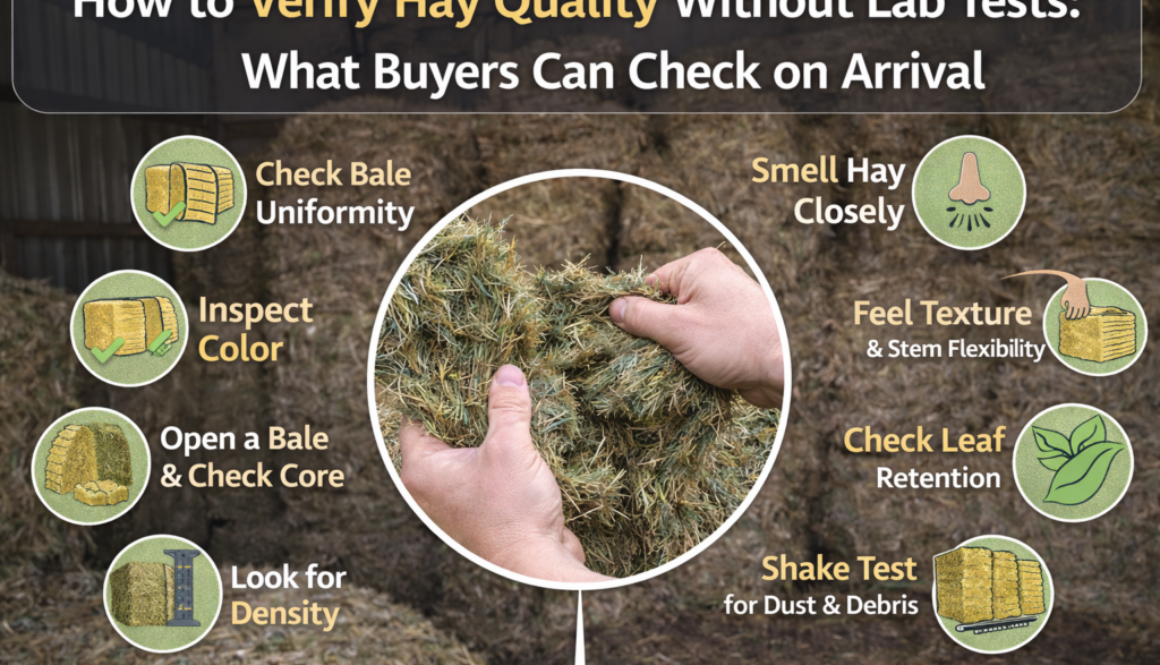
How to Verify Hay Quality Without Lab Tests: What Buyers Can Check on Arrival.
Lab tests provide valuable data, but many hay-buying decisions happen before test results are available — or without testing at all. When hay arrives on-site, buyers need fast, reliable ways to assess quality using what’s immediately available: sight, smell, touch, and structure.
Fortunately, experienced buyers can detect most quality issues without opening a spreadsheet.
Why Visual and Physical Checks Still Matter
Hay performance is influenced by factors lab tests don’t fully capture:
- Palatability
- Physical texture
- Leaf retention
- Hidden moisture or mold
- Bale uniformity
According to USDA, physical inspection remains a critical part of forage quality evaluation, even when laboratory analysis is used.
1. Start With Bale Uniformity
Consistency tells you a lot before opening a single bale.
Check whether:
- Bale size and shape are uniform
- Density feels consistent from bale to bale
- Twine or wrap tension is even
- No bales appear misshapen or collapsed
Wide variation often signals uneven moisture, maturity, or handling issues.
2. Inspect Color — But Interpret It Correctly
Color is a clue, not a verdict.
Generally favorable signs:
- Green to light green coloration
- Even color throughout the bale
- Minimal bleaching
Warning signs:
- Gray or black patches (possible mold)
- Dark brown hay (heat damage)
- Excessive yellowing (overmature or weathered)
Remember: bright green doesn’t guarantee quality, but dull or dark hay often signals problems.
3. Open a Bale and Check the Core
Never judge hay by the outside alone.
Inside the bale, look for:
- Uniform dryness
- No damp or sticky areas
- No clumping or matting
- Clean separation of flakes
Hidden moisture and mold almost always start in the core, not the surface.
4. Smell the Hay Closely
Your nose detects problems faster than your eyes.
Healthy hay smells:
- Fresh
- Clean
- Mildly sweet or neutral
Avoid hay that smells:
- Musty
- Sour
- Sharp or ammonia-like
Off-odors often indicate heating, fermentation, or mold — even when none is visible.
5. Feel the Texture and Stem Flexibility
Use your hands, not just your eyes.
Quality hay should feel:
- Dry but pliable
- Not brittle or powdery
- Free of excessive dust
Bend a few stems:
- Flexible stems = better digestibility
- Hard, snapping stems = advanced maturity or stress
6. Check Leaf Retention
Leaves carry most of the nutrients.
Watch for:
- Leaves attached to stems
- Minimal leaf shatter at the bottom of the bale
- Uniform leaf presence throughout the bale
Excessive fines and shattered leaves mean lost feed value — regardless of test numbers.
7. Shake Test for Dust and Debris
Lightly shake a flake in sunlight.
Red flags include:
- Visible dust clouds
- Soil particles
- Foreign debris
Dusty hay often causes intake reduction and respiratory stress, especially in confined feeding systems.
8. Assess Bale Density and Compression
Density affects storage, drying, and feeding.
- Overly dense bales may hide moisture
- Loose bales break apart and waste easily
- Consistent compression indicates good baler setup and handling
Density should be firm but not rock-hard.
9. Look for Early Mold Indicators
Even without obvious mold, watch for:
- Slight discoloration
- Faint musty odor
- Warm spots inside bales
If one bale shows signs, others from the same lot may follow.
When Lab Tests Still Make Sense
Visual inspection works best when:
- Buying moderate volumes
- Feeding maintenance animals
- Evaluating known suppliers
Lab testing is still recommended for:
- Large purchases
- Long-term storage
- High-performance, pregnant, or young animals
- Export or premium markets
The best buyers use both tools together.
Final Thoughts
You don’t need lab results to detect most hay quality problems — you need attention, experience, and a willingness to open bales and look closely. Buyers who rely only on paperwork often miss physical issues that animals immediately notice.
Good hay reveals itself the moment you handle it.
External References
- USDA Forage Evaluation and Buyer Guidance
- University Extension Hay Quality Assessment Resources