
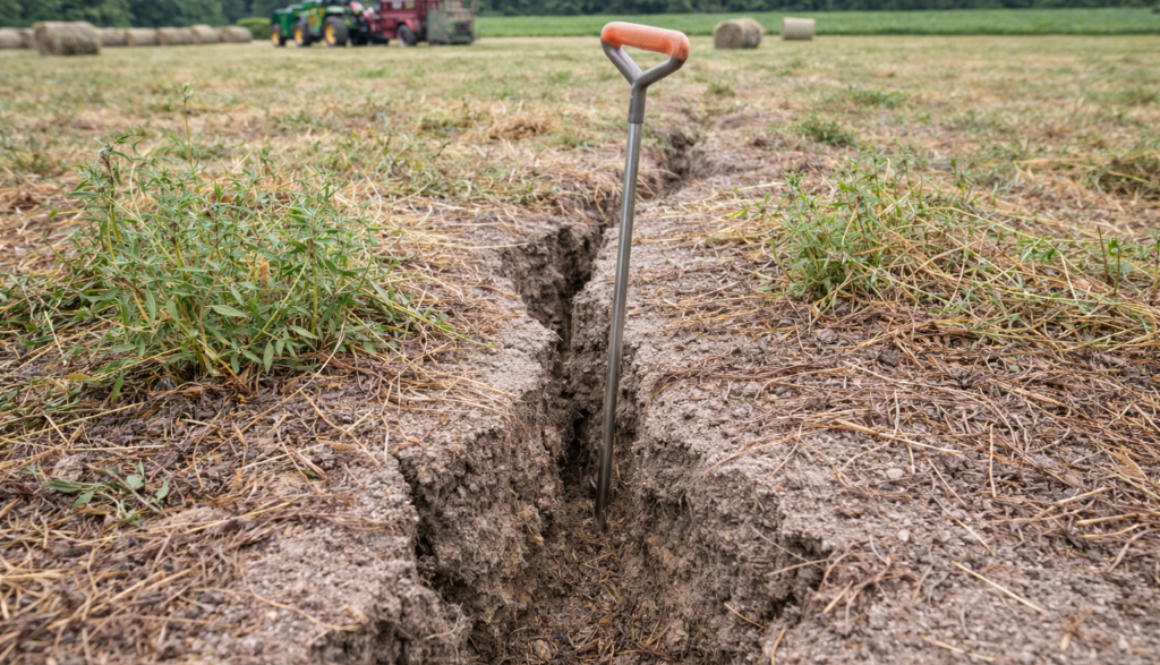
How Soil Compaction Silently Reduces Hay Yields Over Time
Soil compaction rarely causes sudden failure in hayfields. Instead, it works quietly — season after season — reducing root growth, water infiltration, and nutrient availability until yields and stand longevity suffer.
Many producers blame weather, fertility, or stand age without realizing the underlying issue is beneath their feet.
What Is Soil Compaction?
Soil compaction occurs when soil particles are pressed tightly together, reducing pore space needed for:
- Air movement
- Water infiltration
- Root development
- Microbial activity
Once compacted, soil becomes harder for plants to access water and nutrients, even when both are present.
How Compaction Develops in Hayfields
1. Repeated Equipment Traffic
Hayfields often experience:
- Multiple cuttings per year
- Heavy equipment passes for mowing, raking, baling, and hauling
Repeated traffic — especially on the same wheel tracks — gradually compresses soil layers.
2. Field Work on Wet Soils
Operating equipment when soils are wet greatly accelerates compaction.
Wet soil particles slide and pack together more easily, forming dense layers that persist for years.
According to USDA, soil compaction damage is significantly greater when traffic occurs under high moisture conditions.
3. Heavy Loads and Axle Weight
Large balers, bale wagons, and loaders concentrate tremendous pressure at the soil surface and below.
Higher axle weight pushes compaction deeper, sometimes beyond the reach of normal tillage or root penetration.
How Compaction Affects Hay Production
Reduced Root Growth
Compacted soils:
- Limit root depth
- Restrict lateral root spread
- Reduce drought tolerance
Shallow-rooted plants struggle during dry periods, even in otherwise productive fields.
Poor Water Infiltration and Drainage
Compaction slows water movement, leading to:
- Ponding after rainfall
- Increased runoff
- Reduced soil oxygen
This creates stress even during normal precipitation patterns.
Lower Nutrient Uptake
Nutrients may test adequate in soil samples, yet plants fail to access them due to restricted root systems.
This explains why fertilizer applications sometimes produce disappointing results.
Declining Stand Longevity
Over time, compacted fields experience:
- Thinning stands
- Weed invasion
- Reduced regrowth between cuttings
Yield loss often appears gradual — making compaction easy to overlook.
Signs of Soil Compaction in Hayfields
Look for:
- Shallow root systems
- Water standing after rain
- Poor regrowth in wheel tracks
- Reduced yields despite adequate fertility
- Hard soil layers when probing or digging
These symptoms often worsen each season if unaddressed.
How to Reduce and Prevent Compaction
Management Strategies
- Avoid field operations when soils are wet
- Rotate traffic patterns when possible
- Reduce unnecessary passes
- Use lighter equipment where feasible
Biological Tools
- Maintain strong root systems through proper fertility
- Encourage deep-rooted species in mixtures
- Preserve soil organic matter
Mechanical Intervention (When Needed)
- Subsoiling or aeration may help in severe cases
- Results are best when combined with traffic management changes
Why Compaction Is Often Missed
Unlike nutrient deficiencies, compaction doesn’t show clear visual symptoms early on. Fields may look green while producing fewer tons per acre each year.
By the time yield loss is obvious, soil structure has already deteriorated.
Final Thoughts
Soil compaction doesn’t announce itself — it slowly erodes productivity. Identifying and managing compaction early protects hay yields, improves stand longevity, and maximizes returns on every acre.
Healthy soil supports healthy forage, season after season.
External References
- USDA Soil Health and Compaction Resources
- University Extension Soil Management Guides